Introduction to Waves
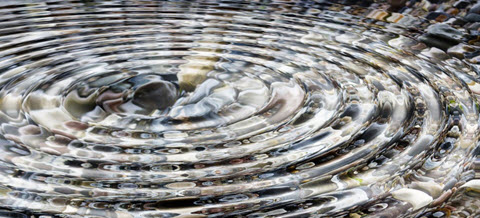
A wave is a disturbance that moves through space or matter.
Examples include water waves, sound and light
The "disturbance" or "variation" can be a change in pressure, electrical intensity or many other things, but there's always a transfer of energy.
And waves vary about some central value due to a "restoring" force, such as a spring, magnetic force, surrounding pressure, and so on.
Longitudinal vs Transverse
First, play with this animation:
Notice how the wave moves but the particles just bounce back and forth (longitudinal) or up and down (transverse), but generally don't go anywhere.
Longitudinal Waves: The disturbance is in the same direction as the wave.
Example: A Spring
The wave moves left to right, and the disturbance moves left and right also.

This spring has a longitudinal wave
Example: Sound

Sound waves are longitudinal.
The air goes between compressed and "rarefied":

The air molecules bounce back and forth a bit but don't travel anywhere.
Transverse Waves: The disturbance is at right angles to the wave's direction.
Example: a water wave travels along the surface, but the water itself moves up and down.

Water waves are mostly transverse: the water particles move in small circles or ovals as the wave passes.
Did you know that lake and ocean waves are mostly caused by wind over the surface?
While we study pure transverse and longitudinal waves separately, real-world waves can be a mix of both.
For example, water particles in an ocean wave move in circular paths, combining up-and-down (transverse) and back-and-forth (longitudinal) motions.
Transfer Energy not Matter
Waves transfer energy, not matter. The matter moves up and down (transverse), or back and forth (longitudinal), but ends up in about the same place after the wave passes.
Shapes

We often show waves as simple "sine waves"
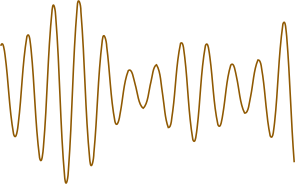
But they can be a lot more interesting!
In fact waves can add to each other in an effect called superposition:

Here two different sine waves add together to make a new wave.
Mechanical vs Electrical
Mechanical waves travel through matter only.
They can't travel through a vacuum.

Example: Sound Waves
Air molecules collide with each other, after a collision one bounces back and the next bounces forward, and so on.
Thus they don't really travel anywhere, but the energy goes forward.
Electromagnetic waves can travel through a vacuum.
Radio and microwaves, light, and x-rays are all electromagnetic waves.
Wavelength and Amplitude
The Wavelength is the length from one peak to the next (or from any point to the next matching point):

The Amplitude is the height from the center line to the peak (or to the trough). Or we can measure the height from highest to lowest points and divide that by 2.
Some other useful names:
- Crest: the top of the wave
- Trough: the bottom of the wave
- Center line: the level in the middle
Frequency
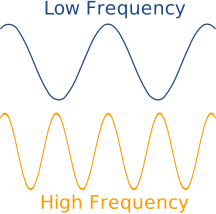
Frequency is how often something happens per unit of time, usually per second.
When frequency is per second it is called "Hertz" (Hz).
Example: 50 Hertz means 50 times per second
Play with Amplitude, Wavelength and Frequency in this animation:
Example: Wave Speed
- Each wave is 2 meters long (wavelength = 2 m)
- 3 waves pass by you every second (frequency = 3 Hz)
How much distance does the wave cover in one second?
2 meters × 3 waves = 6 meters per second
The Wave Speed, Wavelength and Frequency are related like this:
Wave Speed = Wavelength × Frequency
Frequency = Wave SpeedWavelength
Wavelength = Wave SpeedFrequency