Reflection
Waves bounce off a surface at the same angle they strike it:

Angle In Matches Angle Out
Or in more mathematical language:
Angle of Incidence = Angle of Reflection
The Law of Reflection
Another example:

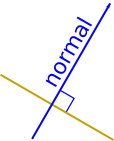
The Normal is the direction directly away from the surface (at right angles to it).
Angles are measured from the Normal.
Mirror
Here we see light bouncing off a mirror to create a "virtual image" that looks like the real thing (but reversed):

Our puppy sees someone in the mirror.
Curved Mirrors
What happens when light reflects off a curved surface? We can draw individual rays of light to discover!
Here's how to work out the reflection of a ray:


The normal line is at right angles to that tangent line

Angle In matches Angle Out either side of the normal line
And we get this:

Our puppy sees an upside down reflection!
Just like the inside of this spoon:
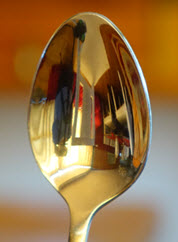
Try it with a shiny spoon:
- Look into the inside of the spoon (curved inward like a cave, or concave): what do you see?
- Try the back of the spoon (curved outward, or convex): what do you see now?
And what about this wonderful shape:
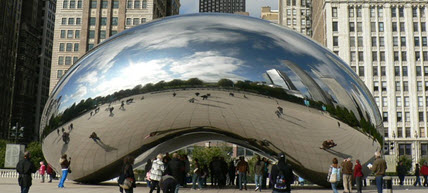
Cloud Gate in Chicago
Parabola
The parabola is a special curved shape that takes any ray coming directly in and sends it to a single "focus" point:

This is useful for telescopes. They can have a large parabolic collection area that sends the radiation to one small detector.

Technicians stand in front of one segment of the James Webb Telescope's
"segmented parabolic reflector"

Incoming radio waves get sent to the focal point for detection.
Plateau de Bure Radio Telescope
Ellipse
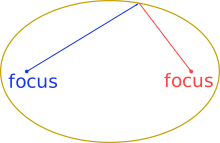
For an ellipse, light or sound starting at one focus point reflects to the other focus point:
Echo

As well as hearing it directly, the sound of this clap
is also heard a short while later from the wall
Other types of waves can have echoes, such as radio waves.