Momentum Animation
Click, drag, release!
Try this: Drag the balls and let them collide. Then change the elasticity setting. What happens when it is 0? What about 1?
Explanation
Collisions can be on a scale of 0 (Inelastic) to 1 (Elastic).
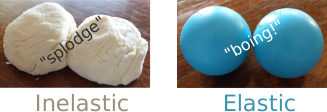
- Inelastic collisions are mushy (like dough balls)
- Elastic collisions are bouncy (like rubber balls)
In the Gravity Animation, the collisions are either inelastic (two objects smashing into each other) or elastic (the objects swing around each other and head off again).
Formula
The formulas used in this animation are:
new va = elast × mb(vb − va) + mava + mbvbma + mb
new vb = elast × ma(va − vb) + mava + mbvbma + mb
Where:
- elast = "Coefficient of Restitution", 0=inelastic, 1=elastic
- va and ma are the velocity and mass of object a
- vb and mb are the velocity and mass of object b
Let's see how these formulas work:
Example: Collision! 2 kg at 3 m/s hits 1kg at rest
- Ball A: mass (ma) = 2 kg, moving at velocity (va) = 3 m/s
- Ball B: mass (mb) = 1 kg, at rest (vb) = 0 m/s
- Elasticity (elast) = 1 (perfectly bouncy)
Let's calculate the new velocity of Ball A:
new va = 1 × 1 × (0 − 3) + 2 × 3 + 1 × 02 + 1
new va = −3 + 6 + 03 = 33 = 1 m/s
Now let's calculate the new velocity of Ball B:
new vb = 1 × 2 × (3 − 0) + 2 × 3 + 1 × 02 + 1
new vb = 6 + 6 + 03 = 123 = 4 m/s
After the collision, Ball A slows down to 1 m/s, and Ball B shoots forward at 4 m/s!