Distance, Velocity, and Acceleration
To understand how things move, there are three main ideas:
- where we are (distance or displacement*)
- how fast we move (speed or velocity*)
- how much we speed up or slow down (acceleration)
Example: A bike race!
You are cruising along in a bike race, going a steady 10 meters every second.

1. Distance (s)
Distance is how far you have moved along your path. We often use the letter s for distance (it comes from the Latin word "spatium"), good not to confuse it with diameter.
If you cycle for 10 seconds at that velocity, your distance is 100 meters.
2. Velocity (v)
Velocity is how fast the distance changes over time:
Velocity = DistanceTime
In the bike race, you travel 10 meters in 1 second, so your velocity is 10 m/s (meters per second).
3. Acceleration (a)
Now you start cycling faster! You increase your velocity to 14 m/s over the next 2 seconds.

When you are accelerating, your velocity is changing. We calculate it by looking at how much the velocity changed and how long it took:
Acceleration = Change in VelocityTime Taken
Your velocity increased by 4 m/s (from 10 to 14) over 2 seconds, so:
Acceleration = 4 / 2 = 2 m/s2
This means your velocity changes by 2 meters per second, every second. That's why we write s2, we are using "seconds" twice!
(In the real world, your velocity and acceleration change moment to moment, but for these questions, we usually assume you are steady!)
Summary Table
| Concept | Symbol | Simple Formula | Example Unit |
|---|---|---|---|
| Time | t | s (seconds) | |
| Distance | s | m (meters) | |
| Velocity | v | Distance / Time | m/s |
| Acceleration | a | Change in Velocity / Time | m/s2 |
Time, Velocity and Distance
We can work one of those out from the other two.
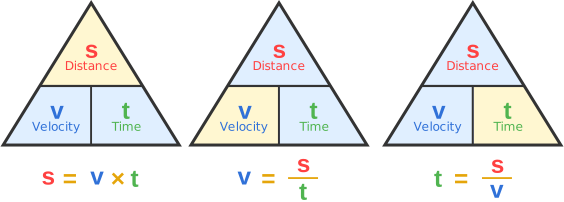
See how the triangle shows you which formula to use?
Example: A train travels at a steady velocity (v) of 50 m/s for a time (t) of 20 seconds. How far does it go?
We want to work out distance
Looking at the triangle, we cover the s. This leaves v and t next to each other, which means multiply:
s = v × t
s = 50 m/s × 20 s
= 1,000 meters
Try changing the graphs below:
Acceleration
From Acceleration to Velocity
When we know our acceleration, we can work out our new velocity! To work out the Change in Velocity, just multiply:
Change in Velocity = Acceleration × Time
Example: You are already cycling at 10 m/s. You accelerate at 2 m/s2 for 3 seconds.
- The change in velocity is 2 × 3 = 6 m/s
- Your new velocity is 10 + 6 = 16 m/s
What about Distance?
When we accelerate, we cover more distance every second because we are getting faster! When we start from a standstill (0 m/s), we can calculate the distance traveled:
Distance = ½ × Acceleration × Time2
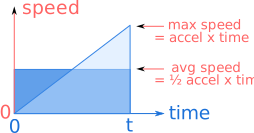
Why is there a ½?
Since we start at 0 and speed up steadily to our final speed, our average speed along the way is exactly half of our maximum speed!
Example: A car starts from 0 and accelerates at 4 m/s2 for 5 seconds.
But wait, there's more!
What happens when acceleration changes? That's called a Jerk (or a Jolt)!
We feel a "Jerk" when a bus driver slams on the brakes or an elevator starts moving suddenly. It is that feeling of being thrown forward or backward as the acceleration changes.
Engineers work very hard to make sure elevators and trains have low "Jerk" so we don't feel sick!
And yes, physicists have a sense of humor. The next levels of motion are actually named:
- Snap
- Crackle
- Pop
So they go:
Distance → Velocity → Acceleration → Jerk → Snap → Crackle → Pop

Footnote
* In Physics:
- distance is called displacement when it has direction
- speed is called velocity when it has direction