Conservation
Conservation: the idea that the total stays the same.
Conservation of Mass
Example: Stone Smash!
Before:

| 30.0g | stone |
After the Hammer:

| 25.0g | stone chunks | |
| 3.0g | stone fragments | |
| 1.8g | smashed away | |
| 0.2g | dust in air | |
| 30.0g | TOTAL |
There's still 30.0g, but now in different forms and places
Note that:
- some of the dust can float away so it may seem that mass gets lost
- or maybe some new dust arrives and settles on the crushed stone

So we also need the idea of an "isolated" or "closed" system, meaning that nothing transfers in or out, and no external force acts on it.
Conserved: the total stays the same (within a closed system).
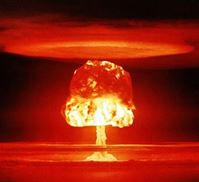
Mass and Energy
At an atomic level Mass and Energy are equivalent (E=mc2) so we should think of mass and energy together as being conserved.
But for everyday use it is OK to think of mass and energy separately.
Conservation of Energy
Energy can be in many forms:



- coiled spring
- motion
- height
- electricity
- ... and more
Energy can go from one form to another, or to heat:

Heat is a type of energy, too. In fact (ignoring mass-energy transforms) the total amount of energy stays the same:
Energy can't be created or destroyed.
Energy is lost to a system when it leaves it. A battery loses energy when it powers a light. Our bodies lose heat all the time.
But when we say "energy is lost as heat" we really mean the energy is dissipated (spread out) into the environment, it is not gone from the Universe.
Conservation of Momentum
Momentum (both linear and angular) is also conserved.
In fact all of these are conserved:
| Conserved | Dimensions |
|---|---|
| Mass | kg |
| Linear Momentum | kg·m/s |
| Angular Momentum | kg·m2/s |
| Energy | kg·m2/s2 |
| Electric Charge | A·s (Coulombs) |
But Why?

As far as modern physics knows, the deepest reason for conservation is symmetry.
In 1915, mathematician Emmy Noether proved that every conservation law comes from a matching symmetry in nature. This result is called Noether's Theorem.
The idea is simple:
- If physics works the same everywhere in space, then momentum is conserved
- If physics works the same in every direction, then angular momentum is conserved
- If physics works the same at every moment in time, then energy is conserved
So energy conservation is a result of time symmetry.
Time Symmetry?
Imagine doing the same experiment today, tomorrow, or next year.
If the laws of physics never change with time, the experiment should behave the same way each time. This is called time symmetry.
Energy is conserved because the laws of physics don't depend on what time it is.
Summary
Conserved: the total stays the same (within a closed system).
Closed System: nothing transfers in or out, and no external force acts on it.
In our Universe:
- Mass is conserved (it can change form, be moved around, cut up or joined together, but the total mass stays the same over time)
- Energy is conserved (it can also change form: to light, heat and so on)
- At an atomic level Mass and Energy can be converted via E=mc2, but nothing gets lost
- Momentum and many other things are also conserved