Present Value (PV)
Money now is more valuable than money later on.
Why? Because you can use money to make more money!
You could run a business, or buy something now and sell it later for more, or simply put the money in the bank to earn interest.
Example: You can get 10% interest on your money.
So $1,000 now can earn $1,000 x 10% = $100 in a year.
Your $1,000 now can become $1,100 in a year's time.
Present Value

So $1,000 now is the same as $1,100 next year (at 10% interest).

We say the Present Value of $1,100 next year is $1,000
Because we could turn $1,000 into $1,100 (if we could earn 10% interest).
Now let's extend this idea further into the future ...
How to Calculate Future Payments
Let's stay with 10% Interest. That means that money grows by 10% every year, like this:

So:
- $1,100 next year is the same as $1,000 now
- And $1,210 in 2 years is the same as $1,000 now
- and so on
In fact all those amounts are the same (considering when they occur and the 10% interest).
Easier Calculation
But instead of "adding 10%" to each year it is easier to multiply by 1.10 (explained at Compound Interest):

So we get this (same result as above):

To convert the interest rate to a multiplier: turn the percentage into a decimal and add 1. Examples:
- 6% becomes 0.06 as a decimal, then add 1 to get 1.06
- 14% becomes 0.14 as a decimal, then add 1 to get 1.14
- 0.5% (half a percent) becomes 0.005 as a decimal, then add 1 to get 1.005
Future Back to Now
And to see what money in the future is worth now, go backwards (dividing by 1.10 each year instead of multiplying):

Example: Sam promises you $500 next year, what's the Present Value?
So $500 next year is $500 ÷ 1.10 = $454.55 now (to nearest cent).
The Present Value is $454.55
Example: Alex promises you $900 in 3 years, what's the Present Value?
So $900 in 3 years is:
Better With Exponents
But instead of $900 ÷ (1.10 × 1.10 × 1.10) it is better to use exponents (the exponent says how many times to use the number in a multiplication).
Example: (continued)
The Present Value of $900 in 3 years (in one go):
As a formula it is:
PV = FV / (1+r)n
- PV is Present Value
- FV is Future Value
- r is the interest rate (as a decimal, so 0.10, not 10%)
- n is the number of years
Example: (continued)
Use the formula to calculate Present Value of $900 in 3 years:
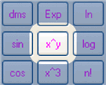 |
Exponents are easier to use, particularly with a calculator. For example 1.106 is quicker than 1.10 × 1.10 × 1.10 × 1.10 × 1.10 × 1.10 |
Let's use the formula a little more:
Example: What's $570 next year worth now, at an interest rate of 10% ?
But your choice of interest rate can change things!
Example: What's $570 next year worth now, at an interest rate of 15% ?
Or what if you don't get the money for 3 years
Example: What's $570 in 3 years worth now, at an interest rate of 10% ?
One last example: