Exterior Angles of Polygons
An exterior angle is the angle between one side of a shape and a line extended from the next side.
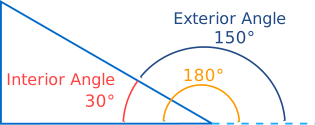
More examples:


When we add up the interior angle and its matching exterior angle we get a straight angle 180°, so they are supplementary angles.
Exterior Angle + Interior Angle = 180°
Polygons
A Polygon is any flat shape with straight sides
The exterior angles of a polygon add up to 360°
In other words the exterior angles add up to one full revolution.
Press Play button to see.
(Exercise: try this with a square, then with some interesting polygon you invent yourself.)
Note: This rule only works for simple polygons.

We can also think "each line changes direction
until we get back to the start again":
Imagine walking all the way around a park along straight paths:
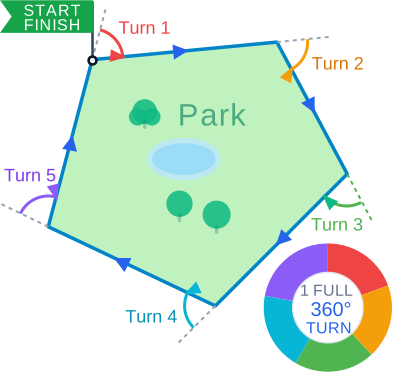
At each corner, you turn by the exterior angle. When you get back to your starting point you have made one full turn of 360°.
Regular Polygons
In a regular polygon, all sides and all angles are equal. That means all exterior angles are equal, too!
Exterior Angle of a Regular Polygon = 360°n
(where n is the number of sides)
Example: What's the exterior angle of a regular octagon?
An octagon has 8 sides, so n = 8:
Exterior angle = 360°8 = 45°
We can also find each interior angle: 180° − 45° = 135°.