Volume of Horizontal Cylinder
How do we find the volume of a cylinder like this one, when we only know its length, radius, and how high it is filled?
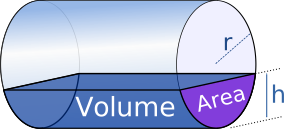
The liquid forms a circular segment at each end of the tank.
First we find the area at one end (explanation below):
Area = cos-1(r − hr) r2 − (r − h) √(2rh − h2)
Where:
- r is the cylinder's radius
- h is the height the cylinder is filled to
- use radians on your calculator (not degrees)
Then multiply by the length to get the volume:
Volume = Area × Length
Why calculate area first? So we can check to see if it is a sensible value! We can draw squares on a real tank and see if the area matches the real world, or just think how the area compares to a full circle.
If h = 0, the area is 0
If h = 2r, the area becomes the area of a full circle (πr2)
Calculator
Enter values of radius, height filled, and length, the answer is calculated live:
Area Formula
How did we get that area formula?
First we assume h is between 0 and 2r.
It is the area of a sector (a pie-slice region) minus the triangular piece.
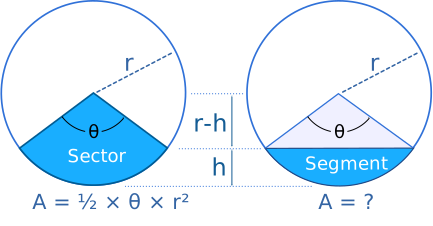
Area of Segment = Area of Sector − Area of Triangle
Looking at this diagram:
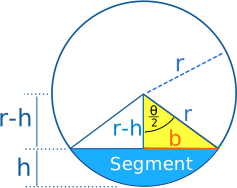
With a bit of geometry we can work out that
θ/2 = cos-1(r − hr)
Area of Sector = cos-1(r − hr) r2
For the half-triangle height = (r − h), and the base can be calculated using Pythagoras:
- b2 = r2 − (r−h)2
- b2 = r2 − (r2−2rh + h2)
- b2 = 2rh − h2
- b = √(2rh − h2)
So that half-triangle has an area of:
So the full triangle area is:
So:
Area of Segment = cos-1(r − hr) r2 − (r − h) √(2rh − h2)