Algebra and Geometry
Did you know Algebra and Geometry go hand-in-hand?
The trick is to use Cartesian Coordinates:
Coordinate Point

Here the point (12,5) is
12 units along, and 5 units up
Cartesian Coordinates can be used to locate a point by how far along and how far up it is:
We can then place shapes like triangles and quadrilaterals onto the coordinate plane and use the power of algebra to discover things about them.
Imagine just one side of a shape, it has two points that make a line segment:
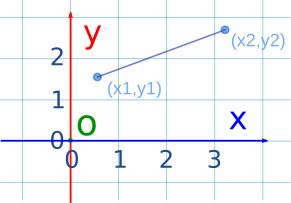
point 1 at (x1,y1) and point 2 at (x2,y2)
Now we can calculate:
The Distance Formula
This tells us how long a line segment is. It is actually just the Pythagorean Theorem (a2 + b2 = c2) in disguise!
Distance = √[(x2 − x1)2 + (y2 − y1)2]
The Midpoint Formula
This finds the point that's exactly in the middle of a line segment. It is the average of the x-coordinates and the average of the y-coordinates.
Midpoint = ( x1 + x22, y1 + y22 )
The Slope Formula
This measures the steepness (gradient) of a line by looking at the "Rise over Run."
See Parallel and Perpendicular Lines, but in a nutshell:
- Parallel Lines have the same slope: m1 = m2
- Perpendicular Lines (lines meeting at a 90° right angle) have slopes that multiply to give −1: m1 × m2 = −1
For Triangles
Here are some ways we can use them with triangles:
- Isosceles triangle: Use the Distance Formula on all three sides. When two sides have equal lengths, it's isosceles
- Equilateral triangle: Use the Distance Formula. When all three sides are equal, it's equilateral
- Right triangle: Use the Slope Formula. When two sides have slopes that multiply to equal −1, they meet at a right angle
Example: Is triangle ABC a right triangle?
The coordinates are A(1, 1), B(4, 5), and C(8, 2).
- Slope of AB = 5 − 14 − 1 = 43
- Slope of BC = 2 − 58 − 4 = −34
Now we multiply them together: 43 × −34 = −1212 = −1
Because the product of the slopes is −1, side AB is perpendicular to side BC.
So, ΔABC is a right triangle!
For Quadrilaterals
Quadrilaterals (4-sided shapes) love to hide their true identities. We can use our formulas to unmask them:
Parallelogram
- Property: Opposite sides are parallel
- How to check: Find the Slope of all 4 sides. Opposite sides must have the same slope
Rectangle
- Property: It's a parallelogram with 90° corners
- How to check: Check if adjacent slopes multiply to −1, or use the Distance Formula to show the two diagonals are equal in length
Rhombus
- Property: It's a parallelogram with 4 equal sides
- How to check: Use the Distance Formula to show all four sides are equal, or use Slope to prove the diagonals are perpendicular
Example: A shape with vertices: P(2, 1), Q(1, 4), R(4, 5), and S(5, 2)
Step 1: Check Slopes (are sides parallel?)
Slope QR = 1/3 and Slope PS = 1/3 (Parallel!)
Slope PQ = −3 and Slope RS = −3 (Parallel!)
Step 2: Check for Right Angles
Slope PQ (−3) × Slope QR (1/3) = −1. (Right angles!)
Step 3: Check Side Lengths
Length PQ = √10 and Length QR = √10. (Equal sides!)
Conclusion: Because opposite sides are parallel, corners are 90°, and sides are equal, it is a Square!
For you: plot it and see.
And this is just the beginning of how Algebra and Geometry can work together.
Summary
- Use Distance for lengths
- Use Midpoint to see if lines cut each other in half
- Use Slope to check for parallel or perpendicular lines